
Is Jell-o Vegan? The Definitive Ingredient Investigation
If you are following a strict vegan diet, the short answer is no: Jell-o is not vegan. While it mimics the texture of fruit-based desserts, the signature 'wobble' comes from gelatin, a protein derived from animal collagen. In this article, we will break down exactly why standard Jell-o fails the vegan test and explore which varieties might be safe.
The Ingredient Breakdown
To understand why Jell-o is off-limits for vegans, we have to look beyond the colorful marketing and analyze the chemistry. The primary culprit is the gelling agent, but a few other ingredients raise questions depending on how strictly you define veganism.
The main offender is gelatin. This is not a plant-based thickener; it is a protein obtained by boiling the skin, tendons, ligaments, and/or bones of animals, typically pigs and cows. It functions by forming a mesh that traps water, creating that distinct semi-solid texture. Because it is a direct animal byproduct, it is strictly non-vegan.
Next, we look at the sweeteners and colors. The sugar used in Jell-o is generally processed using bone char (charred animal bones) to make it white, though the final product contains no bone residue. Strict vegans often avoid this. The Red 40 (Allura Red) is a synthetic dye; while it doesn't contain animal ingredients, it is frequently tested on animals, which conflicts with vegan ethics.
Finally, the adipic acid and citric acid are used for tartness. These are typically derived from non-animal sources (often wheat starch or corn fermentation), so they are technically vegan-friendly. However, they cannot redeem the gelatin content.
Nutritional Value
From a nutritional standpoint, Jell-o is essentially a source of empty calories. A standard serving (about 1/2 cup) contains roughly 70 to 80 calories, almost entirely from sugar (usually around 18 grams).
Because it is made from hydrolyzed collagen, it does provide a small amount of protein (about 1-2 grams), but this is not a 'complete' protein source and does not contribute significantly to muscle health. It contains zero fat and very little sodium, but it lacks vitamins, minerals, or fiber. While it is low-calorie, it spikes blood sugar rapidly without offering satiety.
Frequently Asked Questions
Does Jell-o contain dairy or gluten?
Is Jell-o good for weight loss?
Where can I buy Jell-o?
Is Jell-o safe for kids?
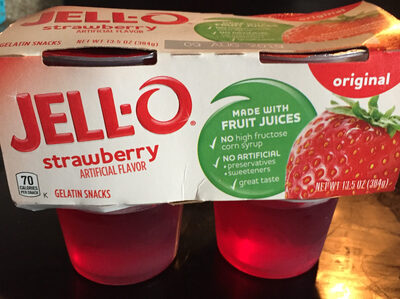
Jell-o
Vegan Analysis
We recommend searching for certified Vegan alternatives.
Pro Tip
Always double-check the label. Manufacturers change ingredients frequently without notice!