
Is Traditional Pork Sausage Vegan?
The short answer is a firm no: Traditional Pork Sausage is not vegan. As the name explicitly states, the primary ingredient is pork, which is an animal product. Beyond the meat itself, the casing holding the sausage together is derived from animal collagen, making it unsuitable for a plant-based diet.
The Ingredient Breakdown
When analyzing a product labeled as Traditional Pork Sausage, the vegan verdict is immediate based on the first ingredient listed: PORK. However, as a food scientist, I look beyond the primary protein source to understand the full composition. The texture and flavor profile of this sausage rely on a specific set of additives.
The meat is suspended in WATER and seasoned with SALT, SPICES, and NATURAL FLAVORS. While these sound innocuous, 'Natural Flavors' in meat products can sometimes be derived from animal sources to enhance the meaty profile, though the specific source isn't always disclosed. To preserve the product and maintain moisture, manufacturers use SODIUM LACTATE (a salt of lactic acid, often derived from fermentation of sugars, but compatible with veganism) and POTASSIUM CHLORIDE.
There are also functional ingredients used for processing. MALTODEXTRIN and DEXTROSE are used as fillers and flavor enhancers. More notably, the ingredient list includes CALCIUM STEARATE and SILICON DIOXIDE. These are anti-caking agents used to prevent clumping in the spice blend. While Calcium Stearate can be plant-derived, it is frequently sourced from animal fats in meat processing, and Silicon Dioxide is a mineral additive.
The most definitive non-vegan element, aside from the pork, is the casing. The sausage is ENCASED IN COLLAGEN CASINGS. Collagen is the structural protein found in the connective tissues of animals—specifically the hides and intestines of cattle or pigs. Even if the filling were plant-based, a collagen casing renders the product entirely animal-derived.
Nutritional Value
From a nutritional standpoint, Traditional Pork Sausage is a high-calorie, high-fat density food. A standard serving typically contains between 250 and 300 calories, with a significant portion coming from fat—often 20 to 25 grams per link. This includes saturated fats, which are generally recommended to be limited in a heart-healthy diet.
Regarding carbohydrates, the inclusion of SUGAR and DEXTROSE adds a small amount of simple carbohydrates to the profile, usually around 2 to 4 grams. While not a high-sugar product, these added sugars contribute to the overall caloric load without providing significant satiety or micronutrients. The sodium content is also quite high due to the salt and sodium lactate, often exceeding 600mg per serving, which is a considerable portion of the recommended daily limit.
Frequently Asked Questions
Does Traditional Pork Sausage contain dairy or gluten?
Is Traditional Pork Sausage good for weight loss?
Where can I buy Traditional Pork Sausage?
Is Traditional Pork Sausage safe for kids?


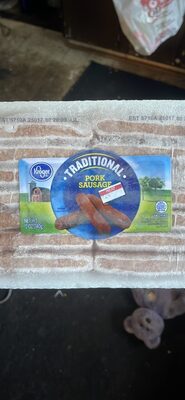
Traditional Pork Sausage
Vegan Analysis
We recommend searching for certified Vegan alternatives.
Pro Tip
Always double-check the label. Manufacturers change ingredients frequently without notice!