Family & Pet Safety
Not Dog Safe 🐶❌
Pregnancy Caution 🤰⚠️
Limit for Kids 👶⚠️
Ingredient Decoder
High Risk Additives
Red 40 (Allura Red)
A synthetic petroleum-based dye used to create bright red colors in candy and drinks. It has been linked to hyperactivity and attention issues in sensitive children. Banned in parts of Europe for use in baby food.
Moderate Caution
Palm Oil
A vegetable fat high in saturated fatty acids. Its massive production is a primary driver of deforestation, endangering species like orangutans. Refined palm oil may also contain harmful contaminants.
Soybean Oil
A ubiquitous vegetable oil high in Omega-6 fatty acids. Excessive consumption of Omega-6s without balancing Omega-3s can promote systemic inflammation in the body.
Maltodextrin
A highly processed white powder from corn or wheat. It has a higher Glycemic Index than table sugar (spiking insulin rapidly) and can suppress good gut bacteria.
Dextrose
A simple sugar chemically identical to glucose. It absorbs instantly into the bloodstream, causing rapid energy spikes and crashes. Often used as a filler.
Disodium Guanylate
Flavor enhancer (E627) often used with MSG. Dangerous for people with gout or kidney stones as it metabolizes into uric acid.
Full Ingredients List:
Diet Compatibility
Vegan
Avoid
Gluten-Free
OK
Keto
Avoid
What you need to know
Fat in high quantity (35.7g)
A high consumption of fat can raise cholesterol and increase heart disease risk. Limit consumption.
Source: National Health Service UK (NHS) - Fat: the facts
Saturated Fat in high quantity (5.36g)
High consumption of saturated fats increases the risk of heart diseases. Choose products with lower content.
Source: National Health Service UK (NHS)
Sugars in low quantity (3.57g)
Low sugar content. Good for weight control and dental health.
Source: National Health Service UK (NHS) - Sugar: the facts
Salt in high quantity (3.21g)
High consumption of salt can cause raised blood pressure and stroke risk. Most people consume twice the recommended limit.
Source: WHO - Fact sheet - Salt reduction
Health Benefits
- ● Low Sugar
Cons & Warnings
- ● Contains Red 40 (Allura Red)
- ● High Sodium
Processing Level
Based on ingredient analysis (NOVA System)
Analysis Report
Data-Driven
CakeID Data Lab
Food Intelligence Engine
"Our algorithms analyze thousands of nutritional labels to find the hidden truths behind your food."
Health Integrity Analysis
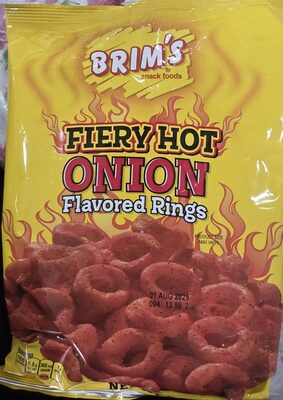
Ever wondered what's really inside Brim's Fiert Hot Onion Rings? We break down the label, macros, and hidden additives so you don't have to. Based on our algorithmic checks, it earns a score of 45/100. Here are the core facts.
⚠️ Additive Watch: Critical Flags
The ingredient list reveals the presence of Red 40 (Allura Red). A synthetic petroleum-based dye used to create bright red colors in candy and drinks. It has been linked to hyperactivity and attention issues in sensitive children. Banned in parts of Europe for use in baby food. For health-conscious consumers, this is a significant red flag that lowered the product's overall score.
Nutritional Balance
With only 4g of sugar, this product maintains a balanced profile. It avoids the excessive sweetness of typical processed foods while providing 4g of protein.
Keto & Diet Matchmaker
For those following a strict Keto diet, Brim's Fiert Hot Onion Rings is highly problematic. A standard Keto diet restricts carbs to about 20g per day. Just 100g of this product contains 54g of carbohydrates, which instantly consumes roughly 270% of your entire daily allowance.
Final Verdict
Taking into account the macro-nutrient balance, additive risks, and caloric density, Brim's Fiert Hot Onion Rings achieves a CakeID Score of 45/100.
Health Recommendations
Sodium Watch
Contains 3.2g salt/100g. Drink water.
More from Brim's
View All

Similar Alternatives


Frequently Asked Questions
Is Brim's Fiert Hot Onion Rings healthy? ▼
Is Brim's Fiert Hot Onion Rings Vegan? ▼
Does it contain harmful additives? ▼
Scan to Verify
Official GTIN Code
Nutrition Facts
Serving Size: 1 package
Calories
* The % Daily Value (DV) tells you how much a nutrient in a serving of food contributes to a daily diet. 2,000 calories a day is used for general nutrition advice.
Burn It Off
To burn off the 571 kcal in 100g, you'd need to:
Sugar Visualization
1 cube ≈ 4g sugar (Contains ~1 cubes)
Macros
FDA Check
Passed. No active recalls.